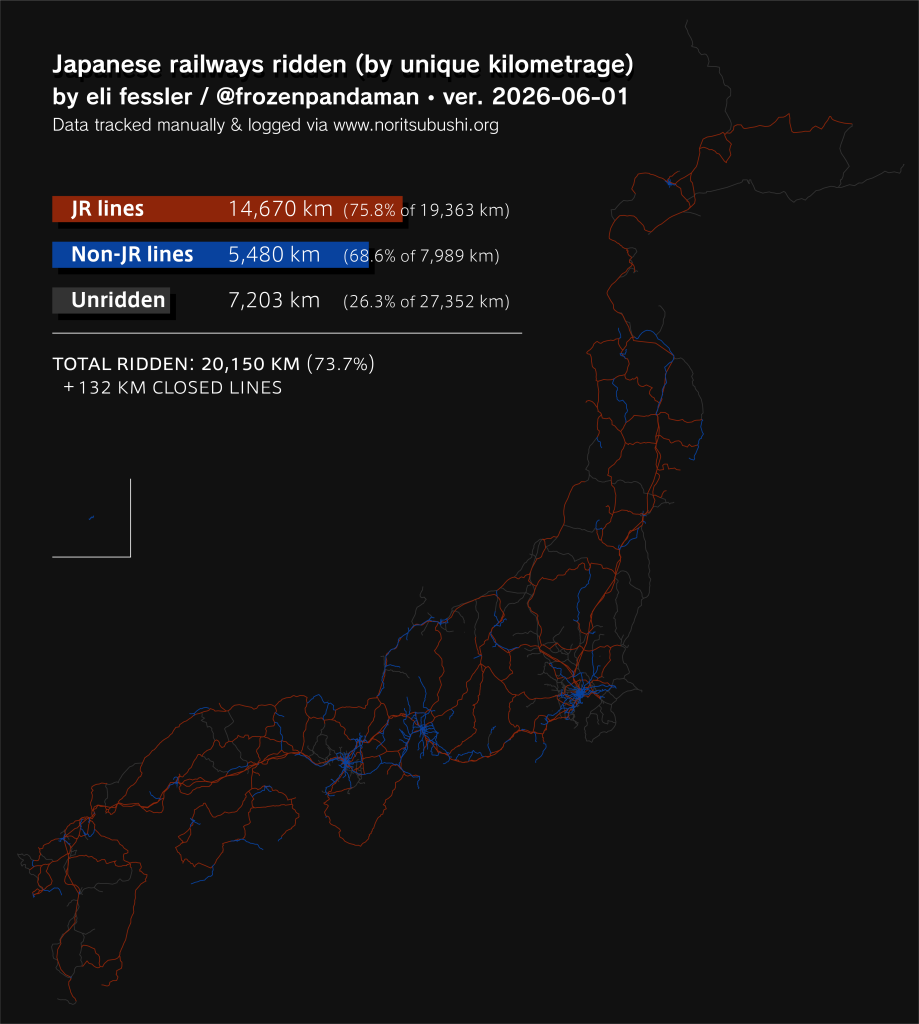
As an archivist at heart (and in practice), I often find myself naturally documenting things, and near the end of 2024, I figured it’d be cool to start tracking all the railways I’d ridden in Japan. Luckily I’d already been saving my IC card history – and between this, record-keeping of my IC card and eki-stamp collections, a lot of cross-referencing stuff with my phone’s camera roll, and some difficult memory-digging, I was able to accurately document pretty much all of the train rides (with dates!) I’d taken in the country. Shortly after, I realized I was pretty close to 10,000 unique km of rail ridden across Japan, so I made it a goal to hit that mark, which I successfully did the following month. At this point, I’m not vying for any specific number, rather just to have as many experiences on as many new railways and lines as possible, and I’ll often go out of my way to ride them along certain routes for the sake of adventure.
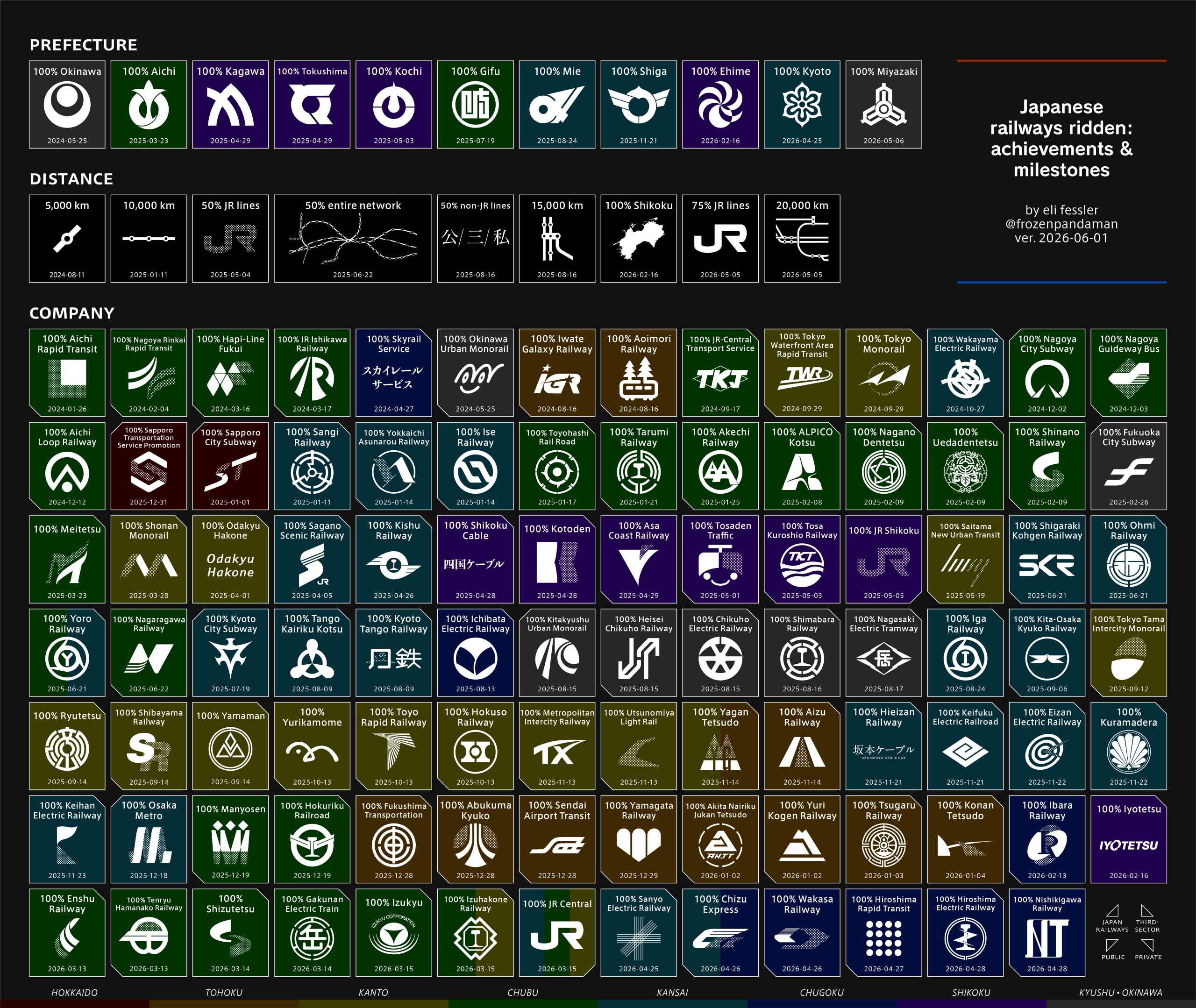
This page shows my “noritsubushi” map, logs for which I record on a Japanese site of the same name and then export to Illustrator to visualize, along with a display of my various “achievements”. The word 乗り nori is the stem for the verb “to ride”, and つぶし tsubushi is a way of saying “doing something completely”, although that second word can also have a meaning of “time-killing” – and while it’s not exactly the intended reading, it’s one I like more in this context. To me, these diagrams are visual representations of my habit of riding public transit around to while away time: as a way to discover new surroundings and communities, and to get the experience of seeing a new route and new scenery on a new vehicle and in a new place.1And for those people that are able to – presumably after many years, and after spending way too much money – ride every route across a whole system, achieving 100% completion of having passed over all railway tracks in a certain place, that’s called 完乗 kanjo. Literally: a complete ride. At its heart, it’s about exploring – one of my favorite things to do in the world!
Distance milestones
- 5,000 km: 2024-08-11 (on JR East’s Shirayuki, Shin-etsu Line)
- 10,000 km: 2025-01-25 (on Akechi Railway)
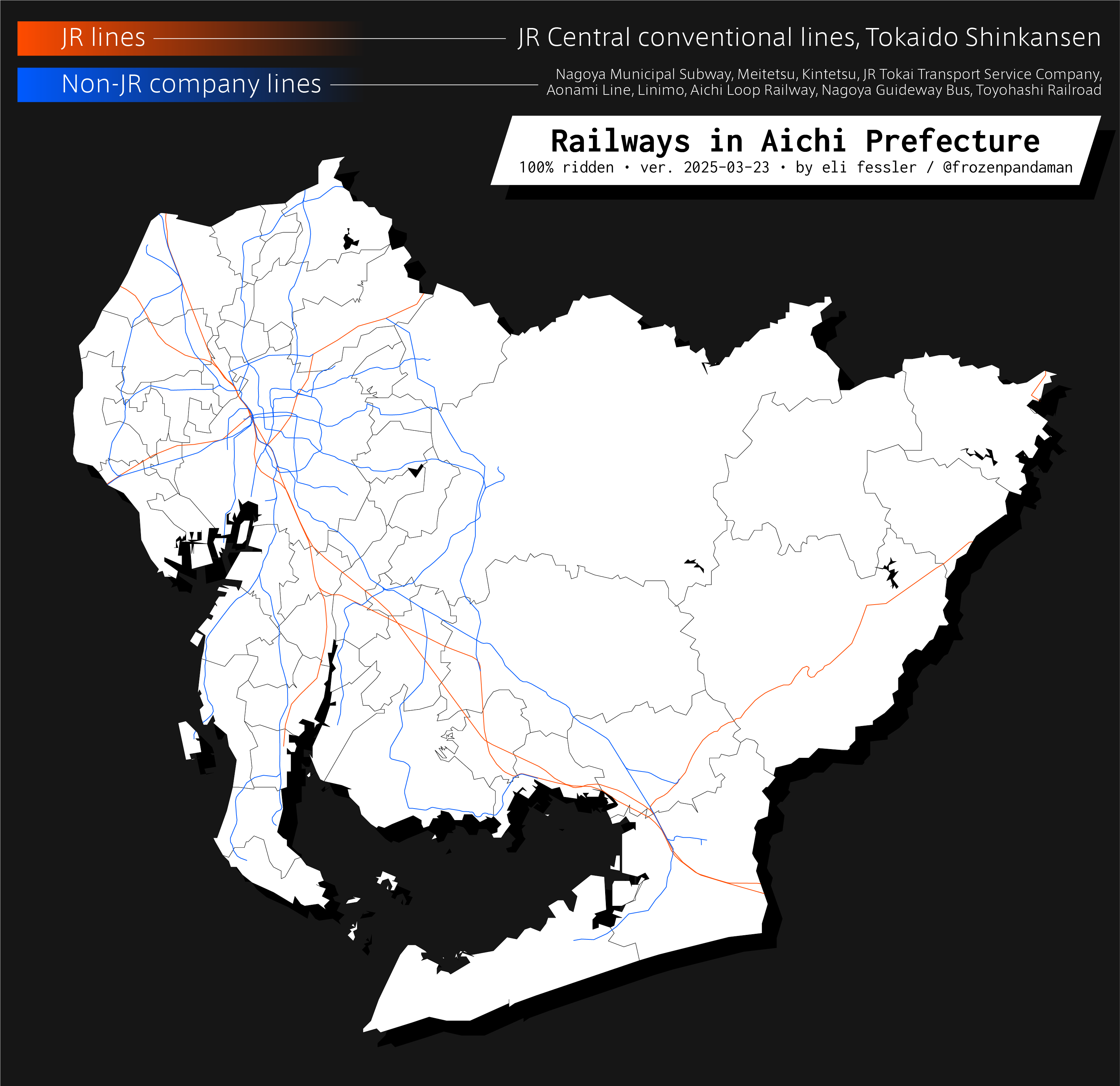
- 100% of Aichi Prefecture: 2025-03-23 (on JR Central’s Taketoyo Line)
- 50% of all JR lines: 2025-05-04 (on JR Shikoku’s Iyonada Monogatari, Aiaru Iyonada Line)
- 50% of all railways: 2025-06-22 (on Nagaragawa Railway)
- 50% of non-JR lines: 2025-08-16 (on Shimabara Railway)
- 15,000 km: 2025-08-16 (on JR Kyushu’s Nagasaki Line)
- 100% of Shikoku: 2026-02-16 (on Iyotetsu’s Honmachi Line)
- 20,000 km + 75% of all JR lines: 2026-05-05 (on JR Kyushu’s Nippo Main Line)
Advanced resources for Japanese transit, ticketing & trip planning
- Yahoo!路線情報 (web) / Yahoo!乗換案内 (app) – directions, timetables & fares
- Ekispert (alternatively Japonyol) – countrywide train route map
- norihodai.com – regional “free pass” info & congestion schedules
- bunkatsu.info – fare, distance & ticket splitting calculations2乗車分割 jousha bunkatsu: https://old.reddit.com/r/Tokyo/comments/1i1rkye/public_transit_quiz_doing_this_made_my_train_fare/m78pr4y/
- loo-ool.com – trainset operational & location info
- Funakiya’s Travel Stamp Book – photos/locations of eki-stamps3Note: info is often outdated or incomplete.
Other noritetsu resources
- Ticketing
- desktoptetsu.com – fare rules & ticket types (in English)
- kiha54500.topaz.ne.jp – JR MARS ticket info4FMI: https://en.wikipedia.org/wiki/MARS_(ticket_reservation_system)
- r113.sakura.ne.jp – ticket simulators
- Railway lines
- Tetsudo no Tabi · Johokan – list of upcoming line closures & openings
- Tetsudo Kyogikai – news on official discussions about unprofitable local lines
- Station info
- railway.sidearrow.net – passenger numbers
- trainfrontview.net – train, building & platform info
- 404fnp.com – fare board photos
- jr-mars.dyndns.org & mars.travel.coocan.jp – MARS terminal installations
- Stamps
- stamp.saloon.jp – stopover, boarding & invalidation stamps5Japanese keywords: 下車印, スタンパー/改札印, 使用済/乗車記念/無効印. Note: info is often outdated or incomplete.
- Blogs